

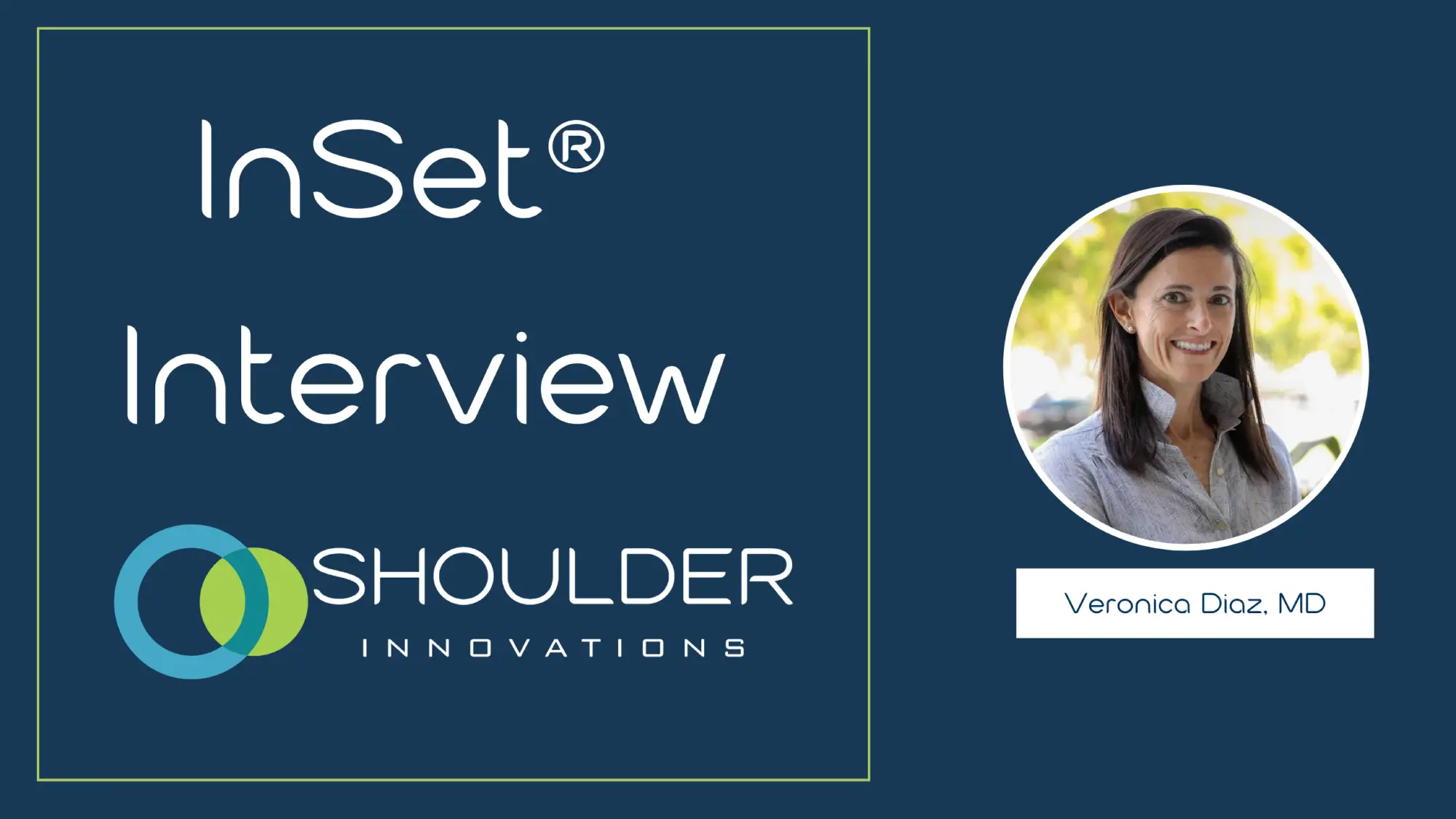
We recently had the opportunity to interview Dr. Veronica Diaz and learn more about her background and experiences using InSet® Systems from Shoulder Innovations in her practice as an orthopedic surgeon.
An edited version of our interview led by David Blue follows.
David Blue:
Thank you for joining us today. Would you please share your background, including how you became involved in healthcare and specifically orthopedics?
Dr. Veronica Diaz:
I was born and raised in Miami, Florida, and I’ve been in private practice in Palm Beach County, Florida since 2010. I did not seriously consider medical school until the final few months of my senior year in college.I took a year off to apply, and when I arrived, the first course in the medical school curriculum at the time was gross anatomy. That course became my favorite pre-clinical experience. It was visual, it made sense, and I genuinely loved it.
What appealed to me about orthopedics was that the anatomy made sense. Form follows function. I also appreciated that it offered a procedural specialty that was not limited to a single patient demographic. Orthopedics is, in many ways, the primary care of surgical specialties in that you treat men, women, children, adolescents, adults, and seniors alike. You get to treat elite athletes and performers, weekend warriors, and patients who just want to be able to remain independent and pain-free for everyday activity.
David Blue:
What attracted you to shoulder as a specialty?
Dr. Veronica Diaz:
My draw toward shoulder surgery came from the breadth of what the specialty encompasses. In lower extremity surgery, a surgeon typically focuses on total joint replacement, ACL and sports medicine procedures, or trauma. As a shoulder specialist, you get to perform arthroscopy, arthroplasty, fracture fixation, and soft tissue repair. You truly get to do it all for a joint that is unique in its function of positioning the hand in space.
David Blue:
What continues to motivate you in shoulder surgery, and what do you find most rewarding?
Dr. Veronica Diaz:
It is mind blowing how much shoulder surgery has evolved since I entered practice. When I was an orthopedic resident, shoulder arthroplasty was in its relative infancy. The reverse shoulder replacement received FDA approval in 2003, and I graduated medical school in 2004. Very few surgeons were performing a high volume of reverses at that point, with perhaps Dr. Frankle being a notable exception. So as trainees, we were learning alongside our mentors who were also figuring out this incredibly impactful surgery.
The same was true in arthroscopy. The sports medicine surgeons who trained me in shoulder arthroscopy were still using instruments like the Caspari punch. Present day suture shuttling methods, anchors, and the broader techniques we rely on now were still in their early stages of development. Now we have the tools to do augmented rotator cuff repair, arthroscopically-assisted tendon transfers, and all arthroscopic bony stabilization procedures. It’s remarkable.
David Blue:
How long have you been using the InSet® system, and what prompted you to evaluate it?
Dr. Veronica Diaz:
This story is a perfect example of how learning and mentorship can be bidirectional.
I serve as a mentor in the American Shoulder and Elbow Surgeons Mentorship Program. My first mentee was Dr. Rich Michelin, a John Itamura Fellow who has since built a formidable shoulder practice in Las Vegas.
One of the requirements of the mentorship program is to complete a site visit with your mentor, so he came and spent time with me. At the time of his visit, I had begun looking at alternatives because I was not willing to accept certain limitations of the implant I was using. I asked Dr. Michelin what he planned to use in practice, and he said Shoulder Innovations. That was the first time I heard about SI. It now has a strong national footprint, but a few years ago it was concentrated regionally in California and the Northeast, with relatively limited market penetration in the Southeast where I practice. That is clearly changing. I then sat on a panel that Dr. Christopher Chuinard was moderating, and talking to him about his experience with Shoulder Innovations really sealed the deal. That is how I became part of the Shoulder Innovations family.
On the anatomic side, I found the InSet® glenoid technology immediately compelling. I wanted to be able to offer anatomic replacement to younger patients with an intact rotator cuff without having to worry about glenoid component loosening 7-8 years down the road. I mean, why haven’t we designed glenoid components this way from the get-go? Such an elegant and simple idea to support the glenoid poly with a rim of osseous support. How wonderful to be able to achieve biplanar correction through a round, low profile glenoid component. Every time I goover a manhole with my car I think to myself: “Why didn’t I think of that?” And now we have data beyond the early favorable biomechanical and finite element analysis studies by Dr. Gunther. The five-year data on the InSet® glenoid is truly disruptive. No revisions and only 1.3% rate of glenoid loosening. On the reverse side, the concept of a lateralized glenoid combined with a lateralized, semi-inlay humeral component appealed to me because of the potential to achieve better functional outcomes, particularly with respect to range of motion. This mattered deeply to me for my female patients. I grew tired of telling them that surgery would help them lift their arm again, but that they might not be able to zip up a dress or fasten a bra. That felt like an outcome we should not have to accept, especially given that reverse shoulder arthroplasty now accounts for the majority of all shoulder arthroplasty procedures performed.
David Blue:
What was your learning curve like when transitioning to the InSet® system? How does it compare to learning other shoulder systems?
Dr. Veronica Diaz:
The learning curve with Shoulder Innovations was pretty forgiving. Probably the stickiest point for me was acclimating to implanting a lateralized glenoid and getting a feel for the tension.
The instrumentation is straightforward. The design rationale made complete sense to me. The preoperative planning software is intuitive and contributes to a very efficient operative experience. The field support was excellent. There was nothing extraneous about the system. The trays contained exactly what was needed, nothing more and nothing less. The only addition I personally requested was a bespoke posterior glenoid retractor, and Shoulder Innovations was so responsive that I had a prototype in hand within about two weeks. That level of responsiveness speaks for itself.
David Blue:
Have you noticed an impact of the one tray TSA and two tray RSA setup?
Dr. Veronica Diaz:
Coinciding with my transition to Shoulder Innovations, I also began shifting a portion of my arthroplasty cases to my ambulatory surgery center. The efficiency of the Shoulder Innovations system translated very well to that setting. The streamlined tray configuration was a meaningful advantage in an ASC environment, where simplicity, efficiency and cost directly impact how the facility operates.
David Blue:
Shoulder Innovations prides itself in having surgeon-driven innovation. How would you compare your experience with SI to other companies you’ve worked with?
Dr. Veronica Diaz:
The Shoulder Innovations team brings a remarkable depth of experience, particularly within the shoulder space. The cumulative years of expertise across the team is nothing short of impressive.
The surgeon thought leaders associated with the company are equally compelling. What stands out about them is not only their clinical expertise, but their values. They put the patient first. They are ethical. They dedicate significant energy to thinking about how to make the system better, and they are engaged for all of the right reasons. When you pair that with a corporate leadership team that is genuinely attentive and accessible, it really does become a recipe for success.
Shoulder Innovations may still be a relatively new shoulder company, but members of this leadership team have been working specifically in the shoulder space since the 1990s in some cases. That level of focused, long-term experience in a single subspecialty is rare and speaks for itself.
In terms of responsiveness and support, I have not encountered better.
David Blue:
If you were sitting down with a colleague who was ready to use InSet® for the first time, what advice would you share with them?
Dr. Veronica Diaz:
My advice to any surgeon considering Shoulder Innovations is simple: reach out. The surgeon leadership team is responsive, approachable, and genuinely happy to answer questions. My own path to SI reflects that. The company sets itself apart in how seamlessly it supports surgeons through the transition, whether they are fresh out of training or making a change after years with another system. I was with the same vendor for 13 years, so I understand how daunting that decision can feel. But I would encourage you to take a closer look, because the leap is not as large as it might seem.
Ultimately, the proof is in the outcomes. I practice in South Florida, where I perform a high percentage of reverse shoulder replacements. The complications that used to keep me up at night, including acromial stress fractures, prosthetic instability, limited internal rotation, anterior conjoint tendon impingement, and persistent pain, have meaningfully diminished with this system. That alone has been significant.
On the anatomic side, there is a particular satisfaction that comes when you lift your thumb off the InSet® glenoid and see that rim of peripheral bone seating perfectly, knowing that component is not going anywhere. We now have the data from Dr. Gillespie and Dr. Johnston confirming exactly that. It is a great feeling, and honestly, it makes it a lot easier to sleep at night.
David Blue:
What has been the feedback received from patients regarding their outcomes or comfort after surgery using the InSet® system?
Dr. Veronica Diaz:
On the reverse side, I no longer hear female patients complain that their bra strap keeps sliding off because the contour of their shoulder has changed. The shoulder contour is more natural. The arc of motion is more natural. The prosthetic stability is remarkable. You can appreciate it even during trialing in the operating room, simply by taking the shoulder through its arc of motion. The impingement-free arc of motion and rotation for behind-the-back and behind-the-head activities has been excellent.
This matters because of where the field is heading. The American, European, and Australian registries all reflect a continued trend toward reverse shoulder arthroplasty. If we are going to be implanting reverses at this volume, we have an obligation to make the reverse shoulder behave as much like a native shoulder as possible. I believe Shoulder Innovations genuinely delivers on that goal.
The same standard applies on the anatomic side. We cannot continue to accept radiolucent lines around the glenoid component in 50 to 70 percent of cases at eight to ten years. If a patient is indicated for an anatomic replacement, we owe it to them to do better than that. The InSet® glenoid addresses that concern directly. The bar needs to be higher, and I think this system reflects that commitment.
David Blue:
Do you have any closing thoughts today?
Dr. Veronica Diaz:
I am mid-career, and I started with Shoulder Innovations in early 2025. Now, roughly a year in, I am genuinely blown away by the trajectory of the company and its leadership. You, Rob Ball, and the medical education team have all made a strong impression. This is where I intend to end my career. I love being part of Shoulder Innovations, and I cannot wait to see what comes next.
What excites me is that SI is not standing still. The system is excellent right now, but I am particularly enthusiastic about the strategic partnership with an enabling technology company that is small, flexible, and well-suited to the ambulatory surgery center environment. I believe it is going to be a major disruptor, especially when you consider some of the competing systems that rely on large robotic platforms on wheels that have to be moved in and out of the room and require capturing an enormous number of data points, all while targeting an anatomical structure roughly the size of an eyeball. The contrast is striking.
Beyond that partnership, I am excited about everything else in the pipeline. The company never stops innovating, which is fitting given the name. That commitment to continuous improvement is exactly what drew me in, and it is what keeps me confident that I made the right decision.
Dr. Veronica Diaz is an orthopedic surgeon in Jupiter, Florida